Monographie
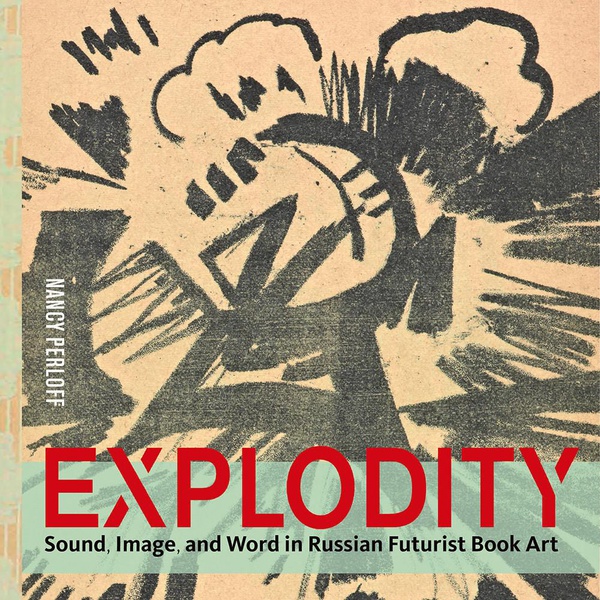
Explodity [Texte imprimé] : sound, image, and word in Russian futurist book art / Nancy Perloff
Type de contenu
- Texte
Type de médiation
- sans médiation
Titre(s)
- Explodity [Texte imprimé] : sound, image, and word in Russian futurist book art / Nancy Perloff
Auteur(s)
Publication
- Los Angeles (Calif.) : Getty research institute
Date de copyright
- C 2016
Description matérielle
- 1 vol. (VII-199 p.) : ill. en noir et en coul. ; 22 cm
ISBN
- 9781606065082
- 1606065084
Note(s)
- "The artists' books made in Russia between 1910 and 1915 are like no others. Unique in their fusion of the verbal, visual, and sonic, these books are meant to be read, looked at, and listened to. Painters and poets--including Natalia Goncharova, Velimir Khlebnikov, Mikhail Larionov, Kazimir Malevich, and Vladimir Mayakovsky--collaborated to fabricate hand-lithographed books, for which they invented a new language called zaum (a neologism meaning "beyond the mind") that was distinctive in its emphasis on "sound as such" and its rejection of definite logical meaning. At the heart of this volume are close analyses of two of the most significant and experimental futurist books: Mirskontsa (Worldbackwards) and Vzorval' (Explodity). In addition, Nancy Perloff examines the profound difference between the Russian avant-garde and Western art movements, including futurism, and she uncovers a wide-ranging legacy in the midcentury global movement of sound and concrete poetry (the Brazilian Noigandres group, Ian Hamilton Finlay, and Henri Chopin), contemporary Western conceptual art, and the artist's book."--ECIP data view
- Notes bibliogr. Index
Note sur le contenu
- From the provinces: anticipations of Mirskontsa ; Sounding the accidental ("death to symbolism") ; Mirskontsa: collaborative book art and transrational sounds ; Unlocking the semantics of sound in vzorval' ; The afterlife of Russian futurist book art.
Résumé ou extrait
- "The artists' books made in Russia between 1910 and 1915 are like no others. Unique in their fusion of the verbal, visual, and sonic, these books are meant to be read, looked at, and listened to. Painters and poets--including Natalia Goncharova, Velimir Khlebnikov, Mikhail Larionov, Kazimir Malevich, and Vladimir Mayakovsky--collaborated to fabricate hand-lithographed books, for which they invented a new language called zaum (a neologism meaning "beyond the mind") that was distinctive in its emphasis on "sound as such" and its rejection of definite logical meaning. At the heart of this volume are close analyses of two of the most significant and experimental futurist books: Mirskontsa (Worldbackwards) and Vzorval' (Explodity). In addition, Nancy Perloff examines the profound difference between the Russian avant-garde and Western art movements, including futurism, and she uncovers a wide-ranging legacy in the midcentury global movement of sound and concrete poetry (the Brazilian Noigandres group, Ian Hamilton Finlay, and Henri Chopin), contemporary Western conceptual art, and the artist's book."--ECIP data view
Sujet - Nom commun
Forme, genre ou caractéristiques physiques
Lien copié.